Alrad Imaging Logo
Specialist supplier of Vision related products for the Machine Vision, Industrial Inspection, Scientific, Research and Microscopy applications
Tel No: UK 01635 30345 ; International +44 1635 30345
Products
Cameras
Camera Cables
Frame Grabbers
Imaging Software
Lenses
Microscopes
Lighting
Test Targets
Calibration Standards
External Links
Photonex
EMC UK
Optics Pages


Machine Vision Cameras
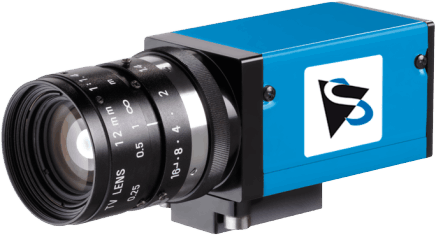
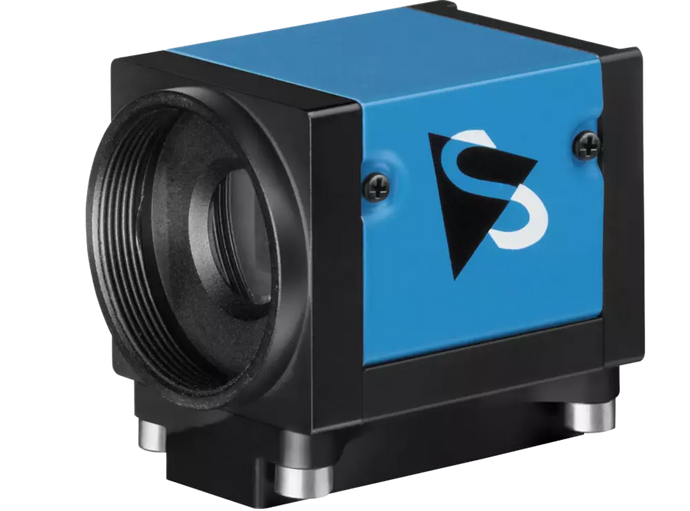
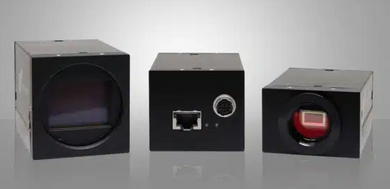
Foculus camera

Are there different types of Machine Vision cameras?

Broadly speaking machine vision cameras can be divided into two types:-

Should I choose a Monochrome or Colour camera? 

Generally our advice here is if you don’t need colour detail always choose monochrome.

There are two reasons

  • 1)      Colour image sensors are monochrome sensors with a matrix colour filter across them.
    There are a number of different filters used but all filters will degrade the image sensor
    sensitivity by around 30 per cent. That means you will have to compensate with more
    light or lower iris setting to let more light into the optic.
  • 2)      The other problem is that in single chip colour cameras the resolution of the colour
    is degraded. This is because the filter colour for one pixel will be different from its
    neighbours. By software correction the resolution is corrected but it’s a assumed
    correction so it will not be as accurate colour representation as that derived from
    a three sensor colour camera where there is a sensor for each of the prime colours
    (blue, green and red) and these are converged to overlap one another by clever
    optical mirrors in the camera head. For really true colour representation a three
    chip colour camera has no equal. 

What’s the difference between CMOS and CCD? 

This is a big subject in itself but we will try and be clear on the main differences 

  • CCD is more sensitive than CMOS mainly because the CCD chips generally have
    100% fill factor where the CMOS is much less ( this means the CCD is 100%
    active sensor while the active part of the CMOS will be no more than 70%
    and some a lot less.
  • CCD is much better for low contrast images. This is because of the lower inherent
    noise in the sensor.
  • CMOS has the advantage of being much more flexible than CCD. You can window
    CMOS sensors to read out less data at a higher frame rate (i.e.: although a sensor
    may have a resolution of say 1280 x 1024 and readout rate of 15 frames per
    second by windowing the sensor and only reading out a 640 x 480 portion of the
    image you can achieve a frame rate of nearly 70 frames per second could be achieved.
  • CMOS sensors have much lower power consumption and therefore are ideal for
    portable devices or space applications.

What type of output should my camera have?  

The type of output will be determined by how you want to read the data out from the camera.


  • Fire Wire (IEEE1394) offers a solution that is also “plug and play” and some cameras
    are now available with high resolution.

There are also older types of LVDS RS644 interfacing still used for digital cameras but these
are being phased out and replaced by Camera Link or Fire wire so is not recommended for
new developments. 

How do I choose a lens for my camera? 

A camera is of no value without a lens or a focusing optic.

For most applications the lens choice depends on:-

  • Field of view required
  • Working distance ( distance between front face of lens and object being viewed)
  • Size of detail required
  • Depth of field required
  • How you are going to use the data captured. (Accurate measurement applications
    for example may require the use of a telecentric or machine vision quality lens)
  • Features required from lens (most lenses are manual iris and focus but other options
    are available such as zoom and motorised lens control.

This guide is not extensive and is no substitute for speaking to one of experienced sales engineers who will be able to assist in the selection of the right camera and lens combination for your application. Also visit the lens section of our web site. We have now included an index selection guide that helps you select the right manufacturers for the type of lens you are looking for.  Or please call our technical sales desk on 01635 30345.

 If you wish to download a copy of this article, click here...

To return to the FAQs & Applications Main Menu, click here...


Further information available from Geoff Smith.

Alrad Imaging, a trading division of Alrad Instruments Ltd.
Alder House, Turnpike Road Industrial Estate Newbury, Berkshire RG14 2NS

Telephone: +44(0) 1635 30345   Fax No. +44(0) 1635 32630
Email: sales@alrad.co.uk


Save yourself time searching for that camera by completing our
VISION QUESTIONNAIRE
It just takes a few minutes to complete and can save you hours of searching

VDS CCD1300 SERIES

Not sure how to select the camera for your application. Why not a look at our helpful
CAMERA SELECTION ADVICE GUIDE